IBM’s big computers of the 1960s to early 1990s were cooled partly with water.[1,3] In the mid-1990s, lower-power CMOS chips let IBM’s servers switch to air.[1] Now the newest AI racks are designed to be cooled entirely by liquid, with warm-water designs, sealed closed loops, and in some places waste heat sent to homes nearby.[2,4,5]
“By 2023, hyperscale and colocation account for 84% of the 66-billion-liter total, while internal data centers fell to just 12%, driven by water efficiency improvements.”[6]Lawrence Berkeley National Laboratory, on U.S. data centers’ direct (on-site) water use, which it says is “primarily associated with cooling infrastructure.” As of Dec 2024.
Timeline
From liquid to air, and back again
1967
Liquid from the start
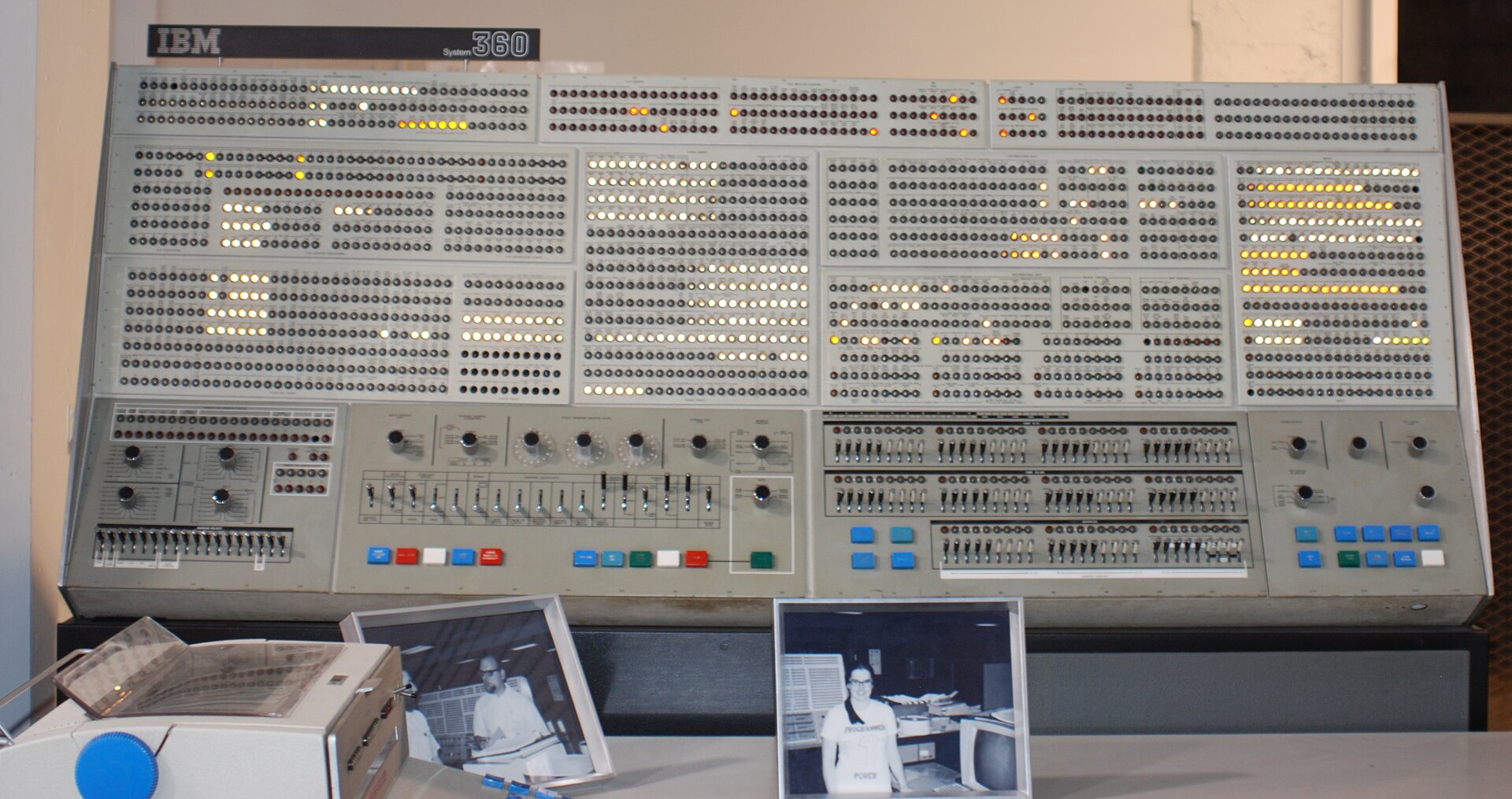
IBM’s System/360 Model 91 used a hybrid air-to-water design: a coolant distribution unit with pumps and a heat exchanger moved 40–79 kW of its heat into building water.[1]
Front panel of an IBM System/360 Model 91, as displayed at the Living Computer Museum, Seattle. Photo: MBlairMartin, CC BY-SA 4.0, via Wikimedia Commons
Early 1980s
Water-cooled modules
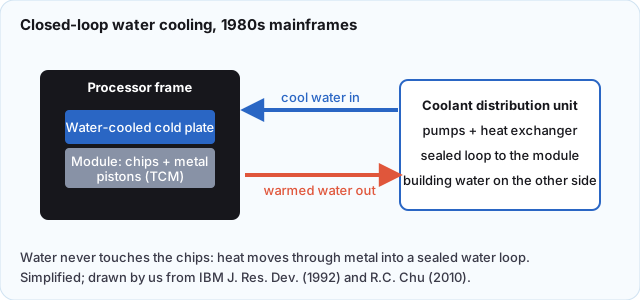
IBM’s Thermal Conduction Module, used in its 3081 and later ES/9000 systems, carried chip heat through metal into water-cooled plates.[1]
Diagram drawn by us from the source cited.
1985
Computers in a bath
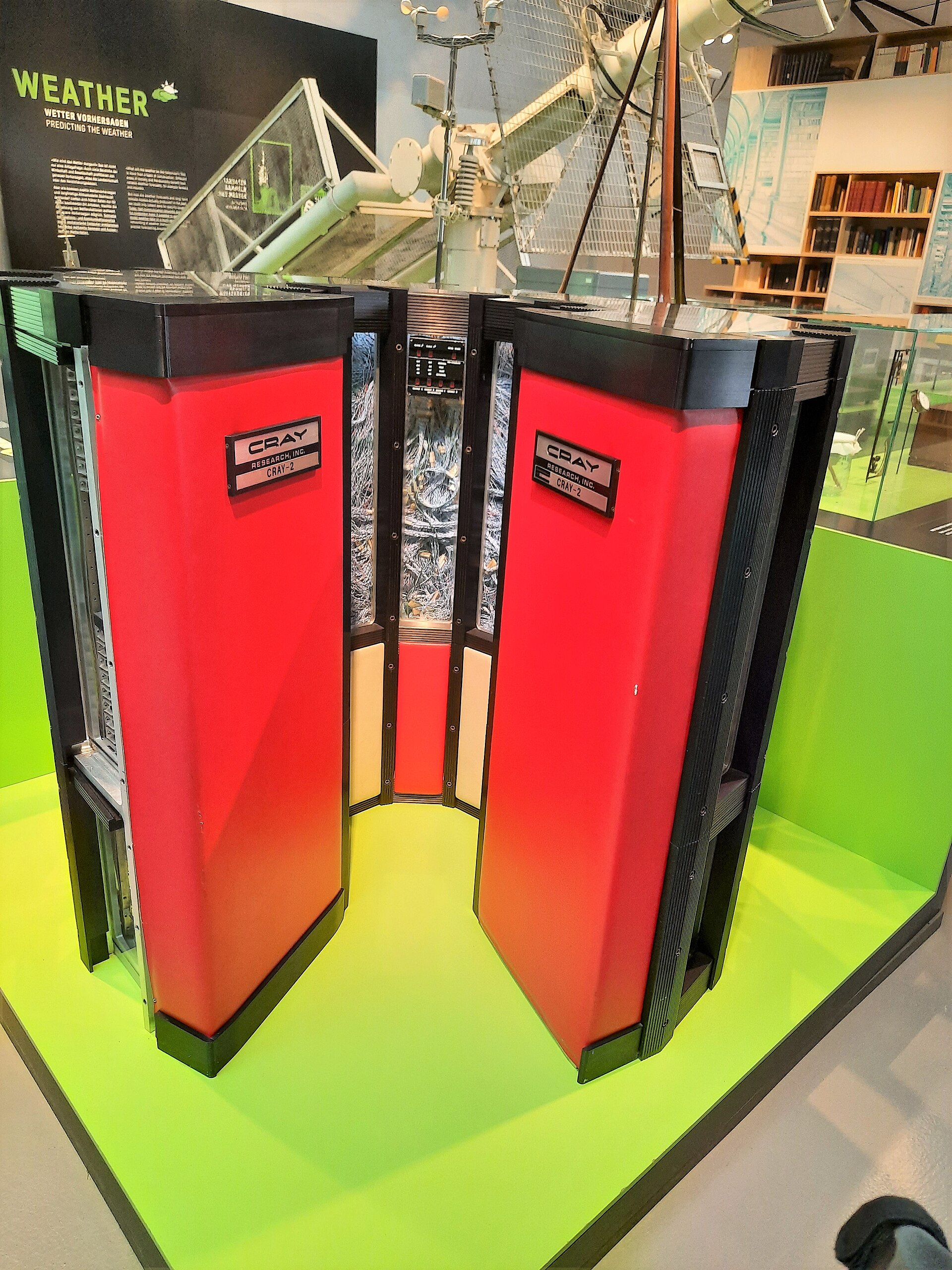
The Cray-2 supercomputer’s circuit boards were immersed in Fluorinert, a liquid that does not conduct electricity.[7]
A Cray-2 supercomputer at the Museum für Verkehr und Technik, Berlin, 2022. Photo: Fridolin freudenfett, CC BY-SA 4.0, via Wikimedia Commons
Early 1990s
Mostly water
In IBM’s water-cooled ES/9000 processors, about 80% of the heat went to a closed-loop water system, supplied at 21.7°C (about 71°F). As of July 1992.[3]
Diagram drawn by us from the source cited.
Mid-1990s
Air takes over
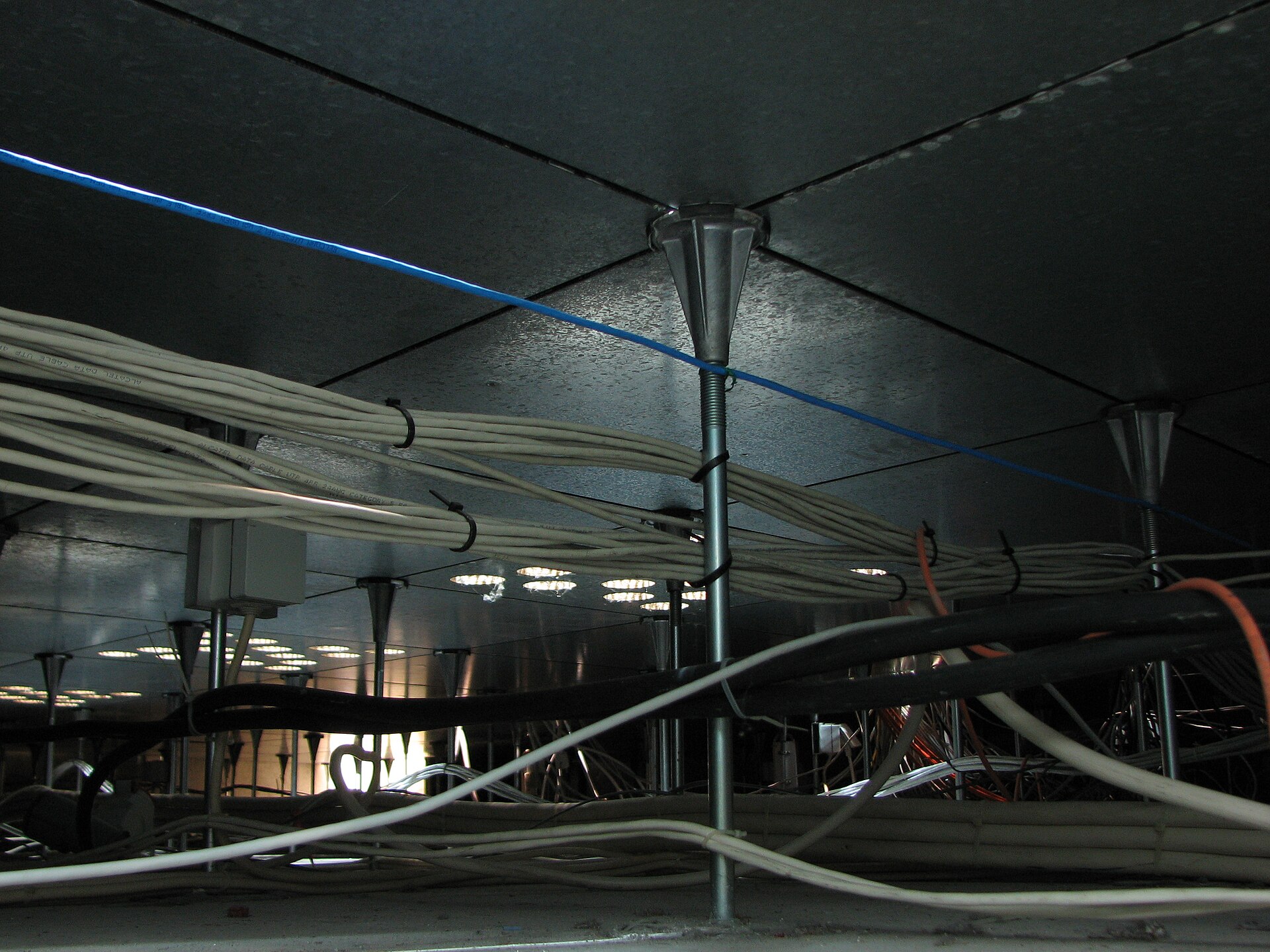
Lower-power CMOS chips let IBM’s servers go fully air-cooled.[1]
Under the raised floor of a data center, 2008. Photo: Adamantios, CC BY-SA 3.0, via Wikimedia Commons
2013
Outside air
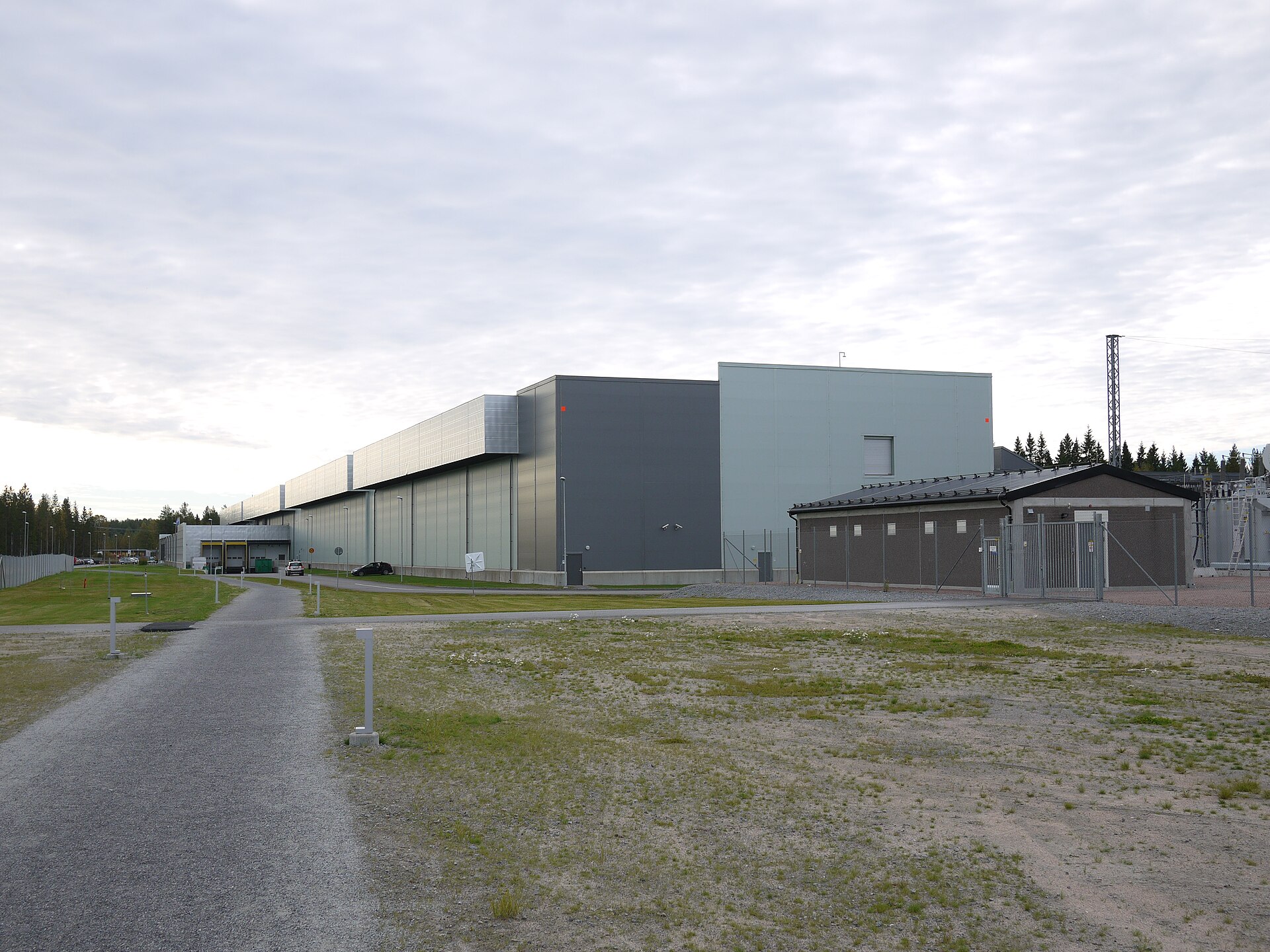
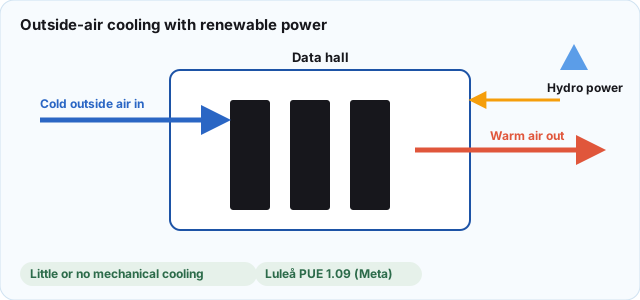
Meta’s Luleå, Sweden data center went live in June 2013 using “chilly Nordic air” to cool its servers and 100% renewable local hydroelectric power.[8]
In early tests, Meta said it averaged a PUE “in the region of 1.07” (as of Jun 12, 2013).[8]
Meta’s data center in Luleå, Sweden, photographed in 2016. Meta says it is cooled with outside air and runs on local hydroelectric power.[8]Photo: Christopher Down, CC BY 4.0, via Wikimedia Commons
2013
Water comes back
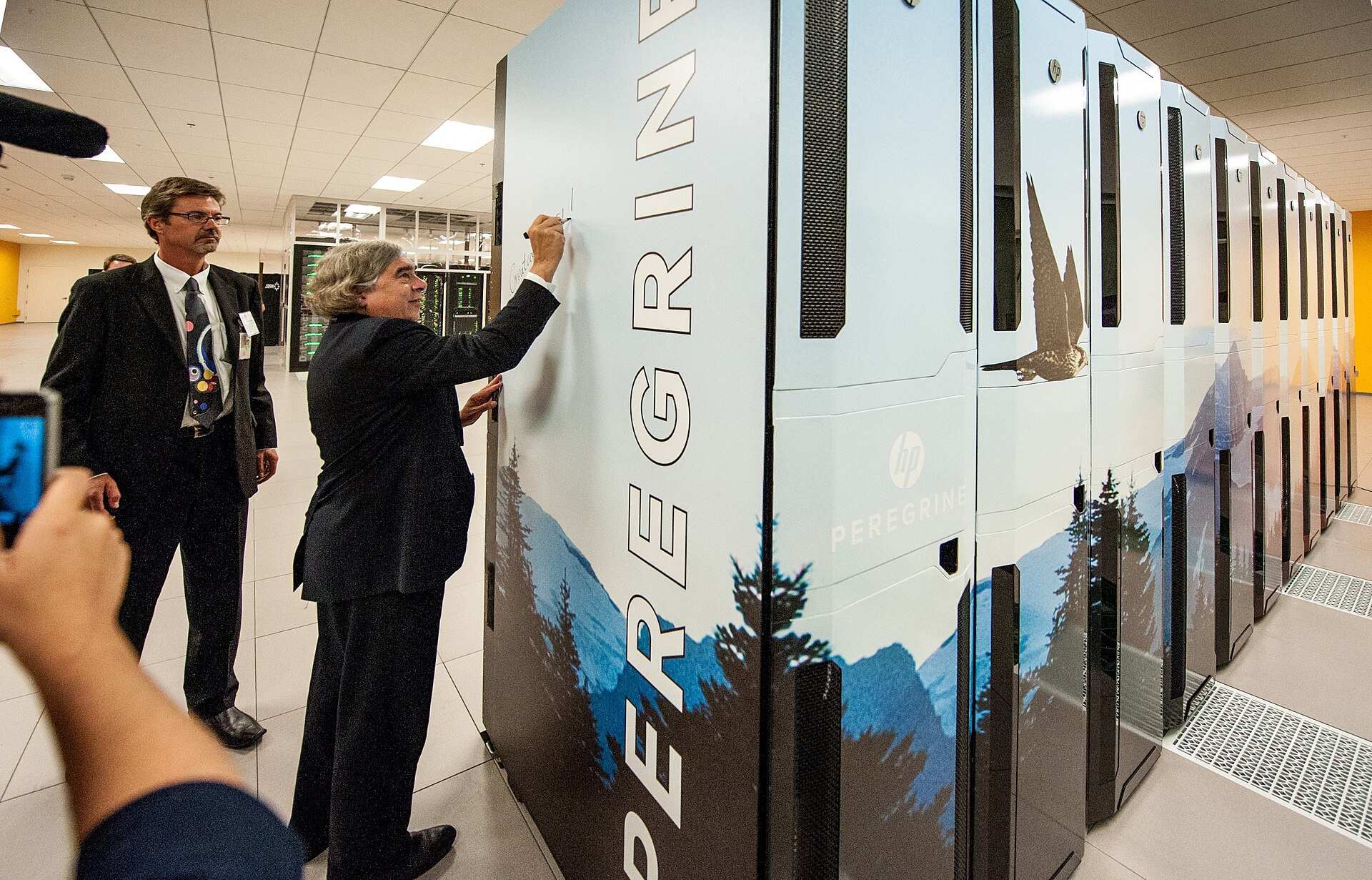
NREL’s data center in Golden, Colorado uses warm-water liquid cooling, and its captured heat warms the building’s offices and other spaces.[9]
NREL reports an annualized PUE of 1.036, compared with an average of around 1.8 that it cites for data centers (undated page, checked Oct 25, 2026).[10]
Unveiling the warm-water, liquid-cooled Peregrine supercomputer at NREL’s data center in Golden, Colorado, 2013. Photo: U.S. Department of Energy, Public domain, via Wikimedia Commons
2017
Immersion returns
Whole servers can sit in a liquid that does not conduct electricity.[11]
Microsoft reported in April 2021 that two-phase immersion cut an individual server’s power use by 5% to 15% in tests in Quincy, Washington.[11]
An immersion-cooling tank, 2017. Servers sit in a liquid that does not conduct electricity.[11]Photo: Rolf Brink, CC BY-SA 4.0, via Wikimedia Commons
2022
Warm water at supercomputer scale
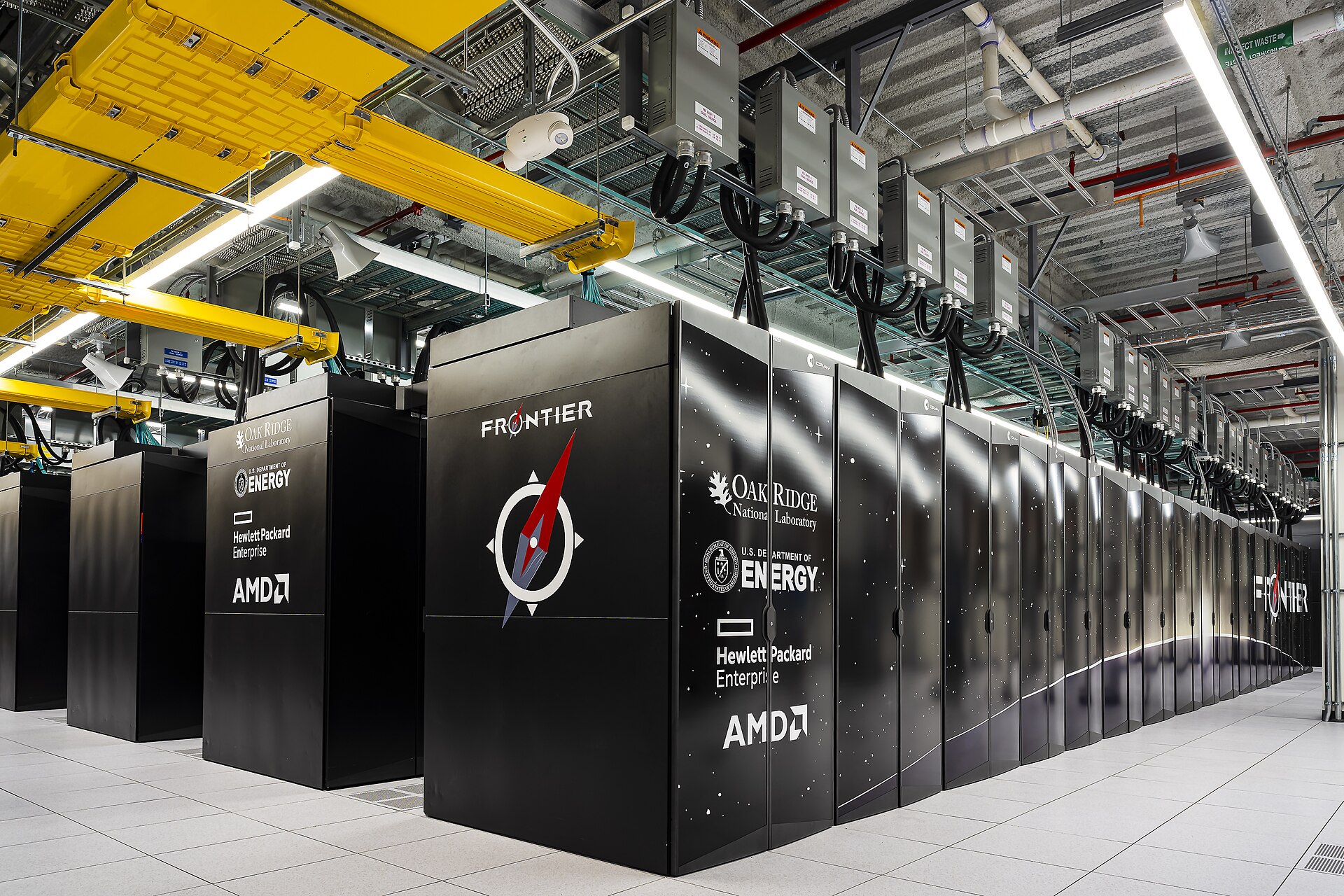
ORNL’s Frontier supercomputer is cooled with warm water, targeted at about 90°F (32°C), so it needs no refrigeration and is cooled by evaporative towers instead (as of Sep 10, 2024).[12]
Frontier at Oak Ridge National Laboratory, 2022. It is cooled with warm water and no chillers.[12]Photo: Oak Ridge National Laboratory, CC BY 2.0, via Wikimedia Commons
2025
Heating homes
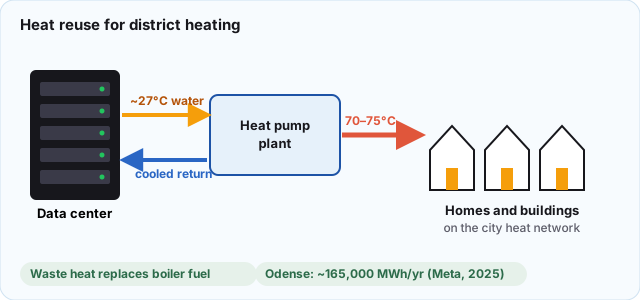
Meta says its Odense, Denmark data center delivers about 165,000 MWh of surplus heat a year to Fjernvarme Fyn’s district heating network, enough for about 9,000 households (as of Feb 2025).[5]
Diagram drawn by us from the source cited.
2026
AI racks with no fans or hoses in the trays
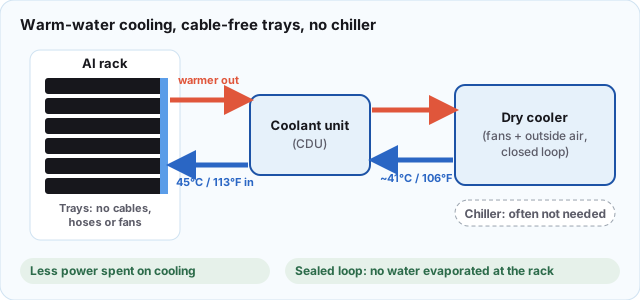
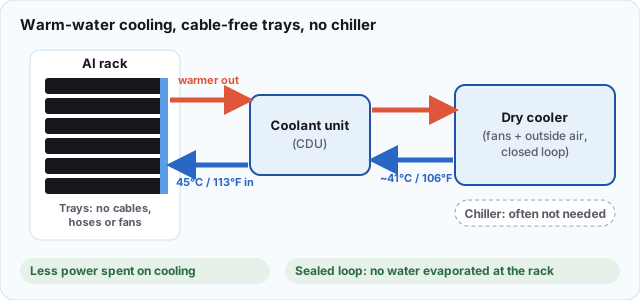
Nvidia says its Vera Rubin rack is 100% liquid-cooled, with cable-free, hose-free and fanless trays, and accepts coolant as warm as 45°C (113°F). Nvidia’s own figures, as of Mar 16, 2026.[2]
Diagram drawn by us from the source cited.
Next?
Breaking the cycle?
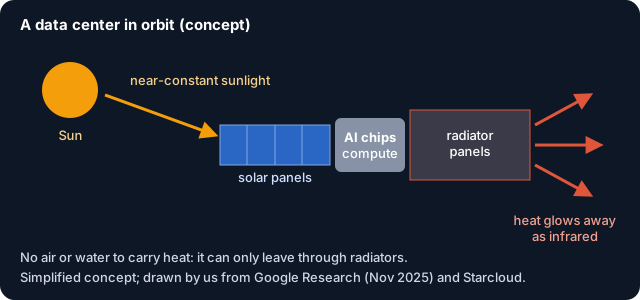
Some companies are now testing computers in orbit. Google says satellites in a dawn–dusk orbit would get near-constant sunlight for power.[13]
Starcloud says its satellites shed heat by radiating it into space, with no water.[14]
Google lists challenges including thermal management, on-orbit reliability, radiation and launch costs.[13]
Starcloud-1 carried an Nvidia H100 GPU into orbit in November 2025.[15]
On Oct 1, 2026, Google said a Project Suncatcher prototype with its TPU chips, built with Planet, had reached orbit on the Transporter-18 rideshare mission.[16]
SpaceX applied to the FCC on Jan 30, 2026 for a “SpaceX Orbital Data Center system” of up to one million satellites. The FCC accepted the application for filing on Feb 4, 2026, which is not an approval.[17]
All are early tests or plans as of Oct 25, 2026.[16,15,17]
Diagram drawn by us from the sources cited.
Good to know
Why water and electronics can mix now
Closed loops
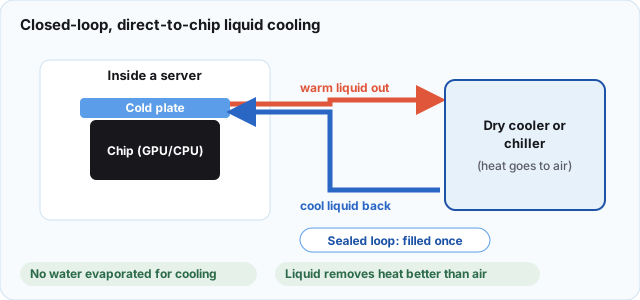
In cold-plate systems, coolant flows in a closed loop through metal plates mounted on the chips, rather than over the electronics.[18,4]
Dripless connectors
Industry-standard quick disconnects are designed to be “drip free” and hot-pluggable, sealing both sides when unplugged.[19]
Leak detection
Leak sensors in compute and switch trays report to the building management system, which can trip a rack’s power breaker and close its coolant shutoff valve.[20]
Carefully chosen coolants
Nvidia specifies PG25, about 75% water and 25% propylene glycol, for its cold-plate loops.[18]
Industry guidelines start from deionized or reverse-osmosis water and call for ongoing checks of conductivity.[21]
Fluids that do not conduct
Immersion systems use dielectric liquids, so whole servers can sit right in them.[11]
Leaks can still happen. Operators treat them as a risk to design for and manage, not one that has gone away.
Interactive explainer
How does a data center stay cool?
Pick a method to see how it works, in plain steps, and why it matters. Facts as of the dates shown; checked Oct 25, 2026.
Evaporative cooling tower
Diagram drawn by us from the sources cited.
How it works
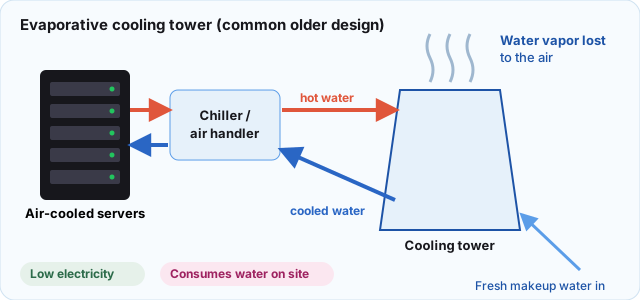
A cooling tower gets rid of heat by letting some of the water evaporate.[22]
Fresh “makeup” water is added to replace what is lost.[22]
Why it matters
LBNL estimates U.S. data centers used about 66 billion liters of water directly in 2023, mostly linked to cooling (as of Dec 2024).[6]
Outside-air cooling
Diagram drawn by us from the sources cited.
Meta’s data center in Luleå, Sweden, photographed in 2016. Meta says it is cooled with outside air and runs on local hydroelectric power.[8]Photo: Christopher Down, CC BY 4.0, via Wikimedia Commons
How it works
In a cold climate, outside air can cool the servers.[8]
Meta’s Luleå site uses “chilly Nordic air” for this.[8]
Why it matters
In early tests, Meta reported a PUE “in the region of 1.07” at Luleå (as of Jun 12, 2013).[8]
A closed loop is filled once during construction and circulates continuously between the servers and chillers.[4]
Why it matters
Microsoft says its designs since August 2024 evaporate zero water for cooling, avoiding more than 125 million liters a year per data center, with a “nominal increase” in energy use (as of Dec 9, 2024).[4]
Warm-water liquid cooling, no chillers
Diagram drawn by us from the sources cited.
Unveiling the warm-water, liquid-cooled Peregrine supercomputer at NREL’s data center in Golden, Colorado, 2013. Photo: U.S. Department of Energy, Public domain, via Wikimedia Commons
How it works
Chips tolerate warm coolant: NREL’s loop takes in water at about 75°F, and Frontier targets about 90°F.[9,12]
At that temperature the water needs no refrigeration and can be cooled by evaporative towers.[12]
Why it matters
NREL reports an annualized PUE of 1.036 for its data center, versus around 1.8 on average (checked Oct 25, 2026).[10]
Immersion cooling
Diagram drawn by us from the sources cited.
An immersion-cooling tank, 2017. Servers sit in a liquid that does not conduct electricity.[11]Photo: Rolf Brink, CC BY-SA 4.0, via Wikimedia Commons
How it works
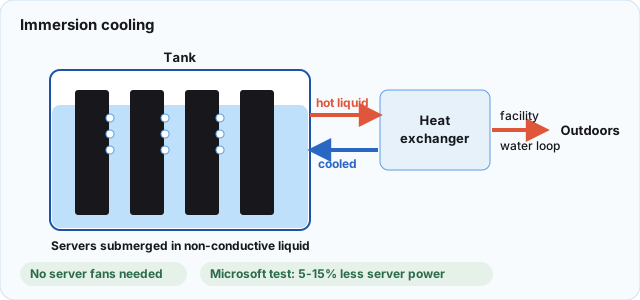
Servers sit in a tank of dielectric liquid made by 3M, which boils at 122°F.[11]
The vapor condenses on a condenser in the tank lid and falls back.[11]
Coils carry the heat to a separate closed loop that goes to a dry cooler.[11]
Why it matters
Microsoft reported in April 2021 that two-phase immersion cut an individual server’s power use by 5% to 15% in Quincy, Washington tests.[11]
Heat reuse for district heating
Diagram drawn by us from the sources cited.
How it works
Surplus heat from the data center goes to a heat pump plant.[23]
The heat pumps raise it to about 70–75°C for the city’s district heating network.[23]
Why it matters
Meta says Odense delivers about 165,000 MWh of surplus heat a year to Fjernvarme Fyn, enough for about 9,000 households (as of Feb 2025).[5]
Warm-water cooling in a cable-free AI rack (Nvidia Vera Rubin)
Diagram drawn by us from the sources cited.
How it works
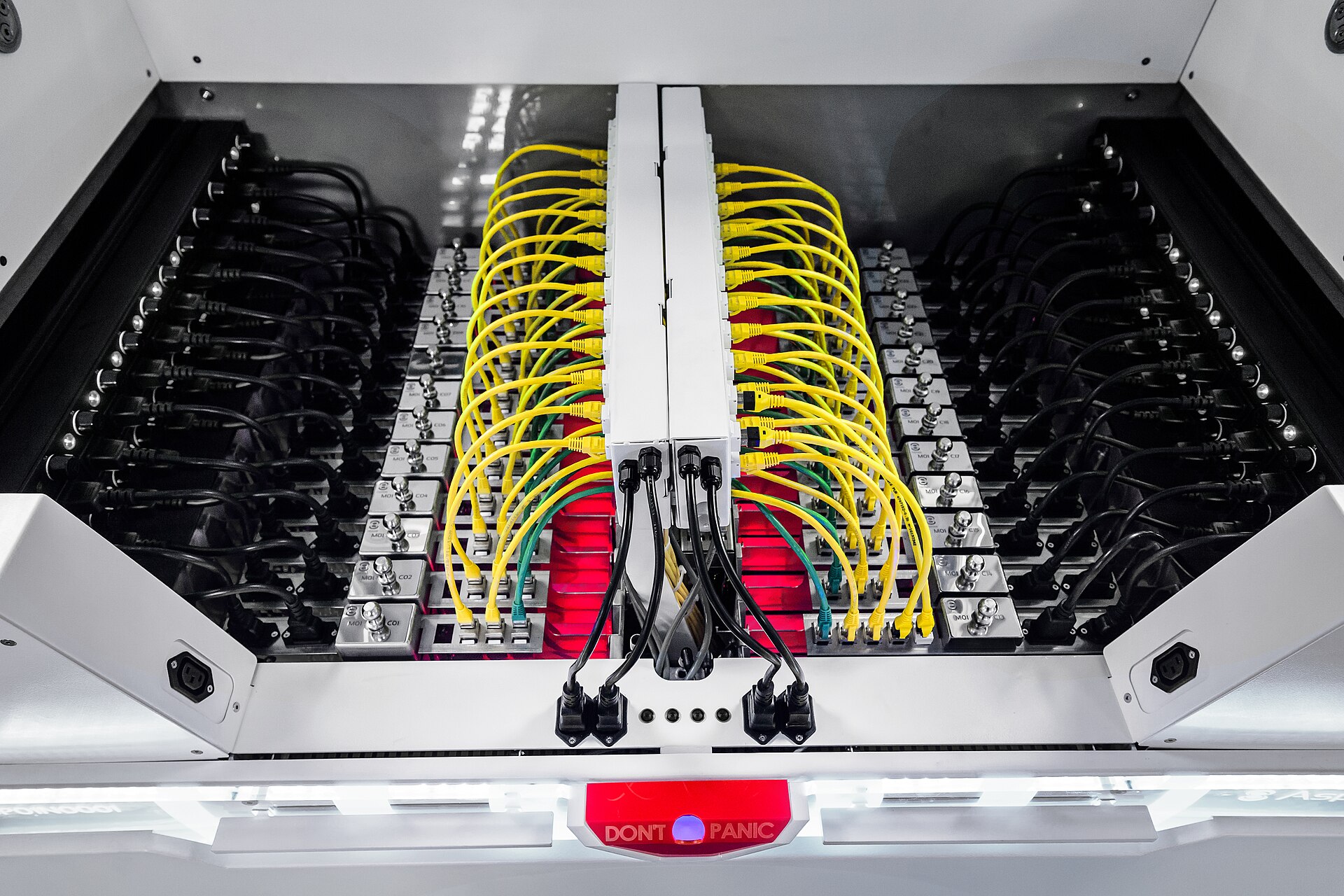
Nvidia’s Vera Rubin NVL72 rack holds 72 Rubin GPUs and 36 Vera CPUs.[2]
Nvidia says the trays are cable-free, hose-free and fanless: parts plug into a circuit-board midplane.[2]
The rack is 100% liquid-cooled and accepts coolant as warm as 45°C (113°F).[2]
Why it matters
Nvidia says coolant that warm lets many data centers use ambient air and closed-loop dry coolers, reducing the need for compressors, and that the power saved could run up to 10% more racks.[2]
Nvidia also says servicing time is up to 18x lower and tray assembly drops from more than 1.5 hours to about 5 minutes. Nvidia’s own figures, as of Jan–Mar 2026; it says the rack ships in the second half of 2026.[24,2]
Data Centers: how they work, what they use, where they are
A sourced guide to the buildings behind AI: what is inside them, how much electricity and water they use, where the big sites are, and which popular claims hold up. Every number links to its source.
Last reviewed Oct 3, 2026
1.5%of global electricity used by data centers in 2024 (415 TWh, IEA)
945 TWhIEA Base Case projection for 2030 (a projection)
22%Ireland’s data-center share of metered electricity, 2024 (CSO)
5,427data centers in the United States, 2025 (Cloudscene via AI Index)
How a data center works
A data center is a building (or a campus of buildings) that houses the servers, storage and networking equipment that run online services, plus the power and cooling equipment that keeps them running. The IEA describes servers, storage and network equipment installed in racks, supported by cooling, uninterruptible power supplies, backup generators and other infrastructure.1
The IEA’s breakdown of where a data center’s electricity goes is below. The shares vary by facility; the IEA gives ranges, not a single split.
Component
Share of data-center electricity (IEA)
What it does
Servers
About 60%
Run the software. AI servers add GPUs and other accelerators, which draw far more power per machine.
Storage
About 5%
Disks and flash that hold data.
Networking
Up to 5%
Switches and links inside the building.
Cooling
About 7% in efficient hyperscale sites; above 30% in less efficient enterprise sites
Removes the heat that servers produce.
Power backup and other
Remainder
Uninterruptible power supplies, backup generators and other building systems.
Source for the table: IEA, Energy demand from AI.1
Types of data center
LBNL sorts U.S. data-center space into internal (in-house), enterprise, colocation (space rented to many customers), hyperscale (very large sites run by the biggest cloud companies), communications service provider and edge types.2 It reports that colocation and hyperscale facilities held 74% of U.S. server capacity in 2023 and projects 85% by 2028, and that the share of server energy used in internal data centers fell from over 60% in 2014 to nearly 10% in 2023.2
Measuring efficiency
Power usage effectiveness (PUE) is the ratio of a facility’s total energy to the energy used by its computing equipment; lower is better (glossary). LBNL reports an average U.S. PUE of about 1.6 in 2014 and 1.4 in 2023, and a projected range of 1.15 to 1.35 by 2028.2
How AI adds to power demand
The IEA reports that electricity use by accelerated servers (those with GPUs and similar chips, mostly for AI) grows about 30% a year in its Base Case, against about 9% for conventional servers.1 LBNL attributes the more-than-doubling of U.S. data-center electricity use between 2017 and 2023 largely to GPU-accelerated servers.2 The IEA says a typical AI-focused data center uses as much electricity as 100,000 households, and that the largest ones now under construction will use about 20 times that.3
LBNL estimates that inference (answering requests) accounted for nearly 60% of AI-server energy in 2023 and projects that training would account for 50–53% by 2028.2 The 2028 figure is a projection.
Power
Confirmed Measured or reported by statistics agencies and research labs. Projections are scenarios and are called out as such.
Worldwide
Data centers used about 415 TWh of electricity in 2024, about 1.5% of global electricity use.3
The United States accounted for 45% of that, China 25% and Europe 15%.3
Data-center electricity use has grown about 12% a year since 2017, more than four times faster than total electricity use.3
Projection: the IEA’s Base Case reaches about 945 TWh in 2030 (slightly more than Japan’s total electricity use today) and about 1,200 TWh in 2035, with a range of 700 to 1,700 TWh across its cases.3
The IEA puts data centers at roughly one-tenth of global electricity-demand growth to 2030.3
The IEA’s Base Case has data-center emissions rising from about 180 million tonnes of CO₂ to about 300 million tonnes by 2035, under 1.5% of energy-sector emissions.3
United States
LBNL: U.S. data centers used 176 TWh in 2023, 4.4% of U.S. electricity. That compares with 76 TWh (1.9%) in 2018.2
Projection: LBNL’s 2028 range is about 325 to 580 TWh, or 6.7% to 12.0% of U.S. electricity.2
Projection: the EIA’s AEO2026 estimates data-center servers at about 7% of commercial-sector electricity use in 2025 and 22% to 33% by 2050, depending on the case.4
The EIA found that growth in U.S. commercial electricity demand between 2019 and 2023 was concentrated in a few states, led by Virginia (+14 billion kWh) and Texas (+13 billion kWh).5
Concentration and the grid
The IEA reports that nearly half of U.S. data-center capacity sits in five regional clusters, and that about half of U.S. capacity now under development is in existing large clusters.3
The IEA estimates that about 20% of planned data-center projects worldwide could be delayed by grid constraints.3
Ireland: data centers used 6,969 GWh in 2024, 22% of the country’s metered electricity, up from 5% in 2015.6
Stanford’s AI Index 2026 estimates that AI data-center power capacity reached about 29.6 GW by the fourth quarter of 2025.7 That is an estimate built from chip data, not a metered figure.
Water
Water use has two parts. Direct use is water a facility itself consumes, mostly for cooling. Indirect use is water consumed by the power plants that supply its electricity. The USGS explains how “consumption” (water not returned to its source) differs from “withdrawal.”8
LBNL: direct water use by U.S. data centers rose from about 21.2 billion liters in 2014 to about 66 billion liters in 2023. Indirect water use associated with their electricity was about 800 billion liters in 2023.2
Projection: LBNL estimates direct water use by hyperscale data centers alone at 60 to 124 billion liters in 2028.2
Reported Google estimates that a median Gemini text prompt uses about 0.26 mL of water. Google says this has not been independently verified.9 See the bottle-of-water myth.
Reported Amazon says that from October to March its Project Rainier data centers in St. Joseph County, Indiana will not use water for cooling, and from April to September only for a few hours a day on an average day.10
Cooling design differs by site and climate, so one site’s figure does not predict another’s. The deeper explanation is on Is data-center water use just cooling?
New rack designs: Nvidia Vera Rubin
Reported Nvidia’s Vera Rubin NVL72 rack puts 72 Rubin GPUs and 36 Vera CPUs into 18 compute trays plus 9 NVLink switch trays, in a rack Nvidia says weighs about 4,000 lbs.11 Nvidia says it is in full production and on track to ship in the second half of 2026.11 The figures below are Nvidia’s own, as of Oct 24, 2026; we have not seen independent measurements.
Diagram drawn by Oh My AI from Nvidia’s published description. Not to scale.
No cables, hoses or fans in the trays. Parts connect through a circuit-board midplane instead of internal cables; Nvidia says assembling a compute tray drops from about 1.5 to 2 hours on Blackwell to about 5 minutes, and that servicing is up to 18 times faster.11,12,13
Liquid cooled. Nvidia says the racks can be 100% liquid cooled, using the same facility cooling infrastructure as its prior generation, with deionized water or a propylene-glycol mix in a closed loop.11
Warm water, fewer chillers. The racks are designed for coolant arriving at up to 45°C (113°F). Nvidia says that lets data centers in many climates cool with outside air and closed-loop dry coolers, reducing the need for compressors, and that the power saved could run up to 10% more racks in the same power budget.11
Smoother power draw. Nvidia says the rack stores 6 times more energy than prior generations to even out sudden swings in demand, reducing peak current demand by up to 25%.11
Warmer coolant does not change how much heat the chips produce; it changes how much extra energy is spent removing it. Total power use still depends on how many racks a site runs.
Major sites and programs by country
Most announced figures are plans or company statements, not measurements, so they carry the Reported label. Capacity is quoted in the unit each source uses (gigawatts of power, not square feet) and should not be added across rows. This is a sample of widely documented projects, not a complete list.
OpenAI said in Sept 2025 that the Abilene flagship site was up and running on Oracle Cloud, and that Stargate had nearly 7 GW of planned capacity and more than $400 billion of planned investment across its sites.14
Reported
Company announcement
United States
Meta, Richland Parish, Louisiana
Meta said in July 2026 that the site will expand to 5 GW of capacity, with an investment of more than $50 billion.15
Reported
Company plan
United States
Microsoft, Mount Pleasant, Wisconsin
Microsoft said on June 23, 2026 that it had completed construction of its first data-center facility there.16
Reported
Company announcement
United States
AWS Project Rainier, Indiana
Amazon says the cluster uses nearly half a million Trainium2 chips and is used by Anthropic; St. Joseph County, Indiana is one of its sites.10
Reported
Company statement
Ireland
National total
Data centers used 22% of metered electricity in 2024.6
Confirmed
National statistics
United Kingdom
AI Growth Zones
The UK Government’s one-year review of its AI Opportunities Action Plan reports five AI Growth Zones, £28.2 billion of related investment and Isambard-AI in Bristol.17
Reported
Government report
European Union
AI Gigafactories
The Commission’s July 30, 2026 call covers up to seven AI gigafactories, with €10 billion of EU and national funding and at least €20 billion of private investment sought; the EU also counts 19 AI Factories.18
Reported
Government call (plan)
China
Eastern Data, Western Computing
In Feb 2022 China approved eight national computing hubs and planned ten national data-center clusters, to move computing resources toward the less developed western regions.19
Confirmed
Government program
India
Google AI hub, Visakhapatnam
Google announced a $15 billion investment for a gigawatt-scale AI hub on Oct 14, 2025.20
Reported
Company announcement
United Arab Emirates
Stargate UAE, Abu Dhabi
OpenAI said in May 2025 that the project is a 1 GW cluster, with the first 200 MW expected to go live in 2026; partners named are G42, Oracle, NVIDIA, Cisco and SoftBank.21 We have not confirmed that any of it is live.
Reported
Company plan
Saudi Arabia
HUMAIN (Public Investment Fund)
The PIF launched HUMAIN on May 12, 2025 to operate across the AI value chain, including data centers.22 The release gives no capacity figure.
Reported
Government-owned company
Singapore
National policy
The Ministry of Digital Development and Information said on Sept 9, 2026 that a Digital Infrastructure Bill will mandate baseline sustainability standards for all data centers and that the government is reviewing whether more capacity is needed.23
Confirmed
Parliamentary reply
How many data centers, by country
Stanford’s AI Index 2026 reports data-center counts for 2025 compiled from Cloudscene.7 These are counts of facilities, not capacity: one hyperscale campus and one small server room each count as one, so the table says little about how much computing a country has. Only the countries the source lists are shown.
Country
Data centers (2025)
United States
5,427
Germany
529
United Kingdom
523
China
449
Canada
337
France
322
Australia
314
Netherlands
298
Russia
251
Japan
222
Brazil
197
Mexico
173
Italy
168
India
153
Poland
144
Myths vs facts
“AI is already using a huge share of the world’s electricity.”
The IEA puts all data centers (AI and everything else) at about 1.5% of global electricity in 2024.3 The growth rate is high, but the share is small today.
Confirmed
“Data centers will use the same share of electricity everywhere.”
Use is uneven. The U.S. share was 4.4% in 2023 per LBNL, and Ireland’s was 22% in 2024 per its statistics office.2,6
Confirmed
“The forecasts are settled.”
They are scenarios. The IEA’s 2035 range runs from 700 to 1,700 TWh, and LBNL’s 2028 U.S. range is 325 to 580 TWh.3,2
Confirmed
“Every AI question uses a bottle of water.”
The one published per-prompt measurement we found is a company estimate of about 0.26 mL for a Gemini text prompt, which Google says is not independently verified. See the myth page for the full discussion.9
Reported
“Data centers mostly use water that is lost for good.”
It depends on the cooling design. LBNL separates direct from indirect use, and Amazon says some of its sites use no cooling water for part of the year.2,10
Reported
“The newest data centers are all the same size.”
The IEA says a typical AI-focused data center draws as much power as 100,000 households and the largest under construction about 20 times that.3
What we left out. We did not include capacity figures we could not find on a primary page, and we did not rank countries by total data-center power because no single source we reviewed compares like with like. See How we verify; report an error through the corrections page.